

Signs your company is flying blind financially show up as more than late invoices and surprise cash shortages; they are structural failures that erode valuation, stall growth, and create investor distrust. Founders, CEOs, and growth-stage leaders need clear, practical signals to diagnose when financial visibility is compromised and actionable steps to restore control. This guide identifies the precise symptoms, explains the underlying mechanics, and gives board-ready, investor-ready solutions—turning fragmented numbers into predictable outcomes like a rolling 13-week cash flow forecast that leads to decisive capital strategy and operational confidence.
Before diving into the first category, understand that financial blindness is rarely a single fault: it’s a cascade where poor data, weak processes, and absent leadership amplify risk. The first set of signs are the most immediate and painful—cash and liquidity problems that force reactive choices.
Cash and liquidity risks: the immediate, visible signs
Cash is the simplest truth in a business. When it’s unpredictable, everything else becomes guesswork. These signs indicate cash and liquidity problems that require immediate remediation to avoid insolvency or a compromised fundraising position.
High and variable burn rate with opaque runway
Burn rate—the net cash outflow per period—is the primary metric investors and boards scan. If monthly cash outflows swing widely because payroll, marketing, or one-off vendor payments aren’t forecasted or controlled, runway estimates are worthless. A reliable runway requires a consistent, reconciled burn calculation and integration with a forward-looking forecast. Replace gut-run numbers with a rolling 13-week cash flow forecast that updates weekly and ties actual bank activity to forecasted receipts and disbursements. That forecast converts uncertainty into a visible time horizon for fundraising, hiring freezes, or cost reshaping.
Delayed receivables and rising AR aging
When accounts receivable past-due buckets grow, cash collection is failing. This is often a symptom of weak billing processes, poor contract enforcement, or disconnected sales-to-COGS recognition. Track DSO (days sales outstanding), implement segmented collection workflows for high-risk customers, and attach cash-collection triggers to customer success and contract renewal processes. Short-term fixes—early-pay discounts, tighter credit terms—should be paired with systemic fixes like automated invoicing and integrated AR aging dashboards.
Unmanaged payables and supplier concentrations
If payables pile up without negotiation or prioritization, suppliers will shorten terms or halt service. Track AP days and supplier concentration; if 30%+ of spend is with one or two vendors, that supplier relationship is a single point of failure. Use staged payment plans, dynamic discounting, and short-term financing only as disciplined bridges—document the strategy in the cash forecast and monitor covenant impacts if debt is used.
Surprise cash shortfalls caused by one-off events
Recurring surprises—tax assessments, legal holds, failed reimbursements—mean controls, accruals, or contingency planning are inadequate. These incidents undermine credibility with lenders and lead to emergency dilution. Maintain a contingency reserve in the cash forecast and build an “exception log” that ties surprises to process gaps; each logged event should translate into a control or policy update.
Transitioning from immediate cash symptoms, the next critical area is the accuracy and usability of the accounting and reporting engine. If the books don’t reflect reality, leaders are forced to decide in the dark.
Accounting accuracy and reporting dysfunctions: symptoms that erode trust
Accurate, timely financial statements are a baseline for decision-making and investor confidence. When reports are late, inconsistent, or unexplainable, strategic choices become gambles. These signs point to structural problems in the finance function.
Persistent late month-end close and unreconciled accounts
A month-end that slips, frequently requires journal-entry fixes, or has unreconciled balance sheet accounts indicates weak close processes and insufficient resources. Month-end discipline matters: it creates a repeatable cadence for variance analysis and executive reporting. Implement a month-end checklist, close calendar with responsible owners, and automated reconciliations (bank and critical balance sheet accounts). Target a predictable close window—no more than 7 business days for growth companies aiming for investor-ready reports—so stakeholders receive timely information.
Financial statements that aren’t GAAP-aligned or board-ready
If the P&L exclude critical items (stock compensation, capitalized R&D, or one-off restructuring costs) or revenue recognition is inconsistent, investors will flag it during diligence. Adherence to basic accounting standards—consistent revenue recognition, correct treatment of capitalized costs, and clear disclosure of non-recurring items—prevents later restatements and valuation haircuts. Build a standard board pack with reconciled P&L, balance sheet, cash flow, and a one-page executive summary that ties KPIs to narrative. Use consistent definitions for metrics across the org so the board can trust the numbers reported from month to month.
Chart of accounts and GL mapping that obscure unit economics
A poorly designed chart of accounts leaves leadership unable to see product, channel, or customer profitability. Redesign the chart for decision-support, not just compliance. Add dimensions (department, product line, customer cohort) and enforce tagging to enable profitability by segment. Well-structured GL mapping accelerates investor diligence and helps build driver-based models that support scenario planning.
Variance analysis absent or shallow
No one-time comparison between forecast and actual makes performance meaningful. Regular variance analysis should explain causes (price, volume, mix, timing) and recommend actions. A disciplined variance pack includes both financial variances and operational KPIs, providing a causal link between execution and results—this is the evidence boards and investors expect when interrogating strategy execution.
With clean books in place, leaders can move from reactive to strategic planning. The next cluster of signs involves forecasting and planning failures that leave executives guessing about future outcomes.
Forecasting and planning failures: when decisions are guesses
Forecasting should reduce uncertainty and enable confident trade-offs. If plans are static or disconnected from drivers, the business will over- or under-invest, mis-time fundraising, and misread growth leverage points.
Static annual budgets detached from drivers
Budgets that are set once a year and sit unused are signals of poor planning discipline. Replace static budgets with dynamic, driver-based forecasts that connect revenue streams, conversion metrics, and cost behavior. Use unit economics—CAC (customer acquisition cost), LTV (lifetime value), contribution margin—to guide marketing and product investments. When a forecast is driver-based, scenario analysis becomes practical: imagine changing CAC or churn and instantly see cash impact.
No scenario or sensitivity analysis for key risks
Businesses face multiple plausible futures. If the finance function cannot model best/worst/base cases and show implications for runway, hiring, and capital needs, executives are flying blind. Build layered scenarios into the financial model: conservative revenue with high churn, optimistic growth with higher CAC, and stress cases for supplier or macro shocks. Each scenario should produce actionable thresholds—e.g., if cash falls below X, pause hiring; if revenue growth hits Y, accelerate product investment.
Poor KPI design and measurement gaps
Tracking vanity metrics rather than actionable KPIs is common. Convert noisy measurements into a concise dashboard of leading indicators (sales pipeline conversion rates, average sale size, retention cohort metrics) and lagging financial outcomes (gross margin, EBITDA, free cash flow). Leading indicators should drive tactical playbooks for sales, success, and product teams tied to the forecast.
Forecasts not used in daily or weekly operations
If forecasts live in a spreadsheet nobody updates, they won’t influence decisions. Embed forecasts into weekly ops reviews and make certain teams maintain the drivers (sales updates, marketing spend, hiring plans). This operationalizes the forecast, creating a feedback loop where real performance refines the model and informs course corrections.
Forecasts and plans are only reliable when backed by solid process, internal controls, and compliance. The next group of signs points to weak controls that increase fraud, error, and audit risk.
Internal controls and compliance failures: hidden risks that escalate quickly
Controls protect assets, ensure correct reporting, and reduce operational risk. When controls are immature or missing, errors and fraud become more likely and diligence becomes painful.

No segregation of duties or over-centralized access
If one person controls invoicing, payments, and reconciliations, the organization is exposed. Implement segregation of duties: one team issues invoices, another approves payments, and reconciliations are independently reviewed. For small teams, use a third-party review (outsourced controller or fractional CFO) to create checks before internal hires scale.
Manual and spreadsheet-driven processes without audit trails
Manual processes generate errors and lack traceability. Replace fragile spreadsheets with systems that provide transaction-level audit trails: automated bank feeds, integrated billing systems, and permissioned access logs. Systems with built-in reconciliation and exception workflows reduce error rates and speed audits.
Tax, payroll, and statutory compliance gaps
Late payroll filings, misclassified workers, or errors in sales tax collection are immediate legal and reputational risks. Conduct a compliance checklist covering payroll, sales and use tax, corporate filings, stock-based compensation reporting, and state nexus issues. For growth companies operating in multiple jurisdictions, allocate resources to tax and legal counsel early to avoid material misstatements.
Poor preparation for investor diligence and audits
During fundraising or acquisition diligence, the first questions center on controls and supporting documentation. A lack of documented policies, inconsistent contracts, and missing bank reconciliations lengthen diligence, reduce valuation, and invite indemnity demands. Prepare a diligence folder with reconciliations, contracts, board minutes, cap table snapshots, and clear narratives explaining accounting policies and revenue recognition.
Controls and compliance tie closely to technology and financial infrastructure. The technology layer either fixes or perpetuates visibility problems—so the next section focuses on system-level signs of financial blindness.
Financial infrastructure and technology gaps: where data becomes unusable
The right systems create a single source of truth. When financial systems are fragmented, poorly integrated, or misconfigured, reporting is slow, error-prone, and impossible to scale.
Spreadsheets are the system of record
Overreliance on spreadsheets for billing, forecasting, or consolidations is a major red flag. Spreadsheets are flexible but fragile. Move transactional processing to an accounting system and use spreadsheets only for analysis. Implement controls around spreadsheet use: versioning, access control, and clearly defined inputs. Centralize raw data in a single, reconciled source before feeding analysis workbooks.
Disconnected systems and missing integrations
When payroll, billing, bank, CRM, and expense systems don’t integrate, reconciling data consumes time and hides issues. Use middleware or an ERP that supports out-of-the-box integrations with CRM (e.g., Salesforce), payroll (e.g., ADP), and payments platforms. For high-growth SaaS companies, integrate subscription billing (Stripe, Chargebee) to ensure revenue data flows correctly into accounting and churn metrics are accurate.
Dirty data and poor master data management
Duplicate customers, inconsistent SKU definitions, and mismatched vendor IDs create noisy reports. outsourced cfo companies governance: unique identifiers for customers, products, and vendors; standardized naming conventions; and periodic data hygiene sweeps. Clean master data improves cohort analysis, margin calculation, and investor-ready reporting.
Poorly designed reporting layer and lack of self-service analytics
Executives waste time requesting bespoke reports when a self-service analytics layer would suffice. Build a reporting layer with clear semantic models and standardized dashboards for executives, product, and sales. Self-service reduces bottlenecks and democratizes insight while preserving the integrity of financial metrics.
Systems alone don’t fix strategic issues like capital structure or investor relations. The next group of signs is about capital strategy and fundraising readiness—areas where visibility, narrative, and documentation intersect to determine access to growth capital.
Capital strategy and investor-readiness failures
Capital strategy is where finance converts visibility into long-term options. Poor capital hygiene sabotages valuation, increases dilution, and constrains strategic choices.
Unclear or messy cap table and equity history
Cap table errors—missing option grants, convertible note terms not modeled, or inconsistent share classes—destroy credibility. Maintain an up-to-date cap table with modeled dilution scenarios for common rounds, down rounds, and employee option exercises. Use professional cap table software or legal counsel to standardize agreements and ensure convertible instruments are accurately reflected in pro forma analyses.
No fundraising model or use-of-proceeds plan
Fundraising without a detailed financial plan and use-of-proceeds is costly. Investors expect a model showing how capital will be deployed and when it will create measurable milestones. Build a fundraising deck with a 24–36 month plan: runway to reach milestone X, expected ARR uplift, margin improvements, and exit or next round scenarios. Tie fund use to operational metrics so investors can validate your ask.
Debt covenant risk and hidden leverage
Undocumented debt, off-balance sheet obligations, or poorly negotiated covenants can surprise management. Maintain a debt register that tracks covenants, maturity profiles, and interest rate exposure. If short-term facilities exist, model covenant floors and create trigger plans for refinancing or covenant relief strategies. Transparent debt management reduces the chance of covenant breaches that can trigger cross-default clauses.
Weak investor reporting and narrative disconnect
Investors want clarity and a consistent narrative linking KPIs to strategic execution. Poorly constructed investor updates—full of irrelevant metrics or missing reconciliations—reduce confidence. Standardize investor reporting with a short executive summary, reconciled financials, KPI dashboard, key hires, and top risks with mitigation plans. A disciplined cadence (monthly or quarterly) builds credibility and eases future raises.
Finally, people and organizational structure catalyze all these issues. The last diagnostic area addresses talent gaps and the strategic role of outsourced financial leadership.
Team, leadership, and the case for outsourced financial leadership
Many firms “fly blind” because they lack the right financial leadership at the right time. Symptoms in the finance organization reveal whether the company needs immediate external expertise or internal rebuilding.
Absence of a strategic CFO or overloaded founder doing finance
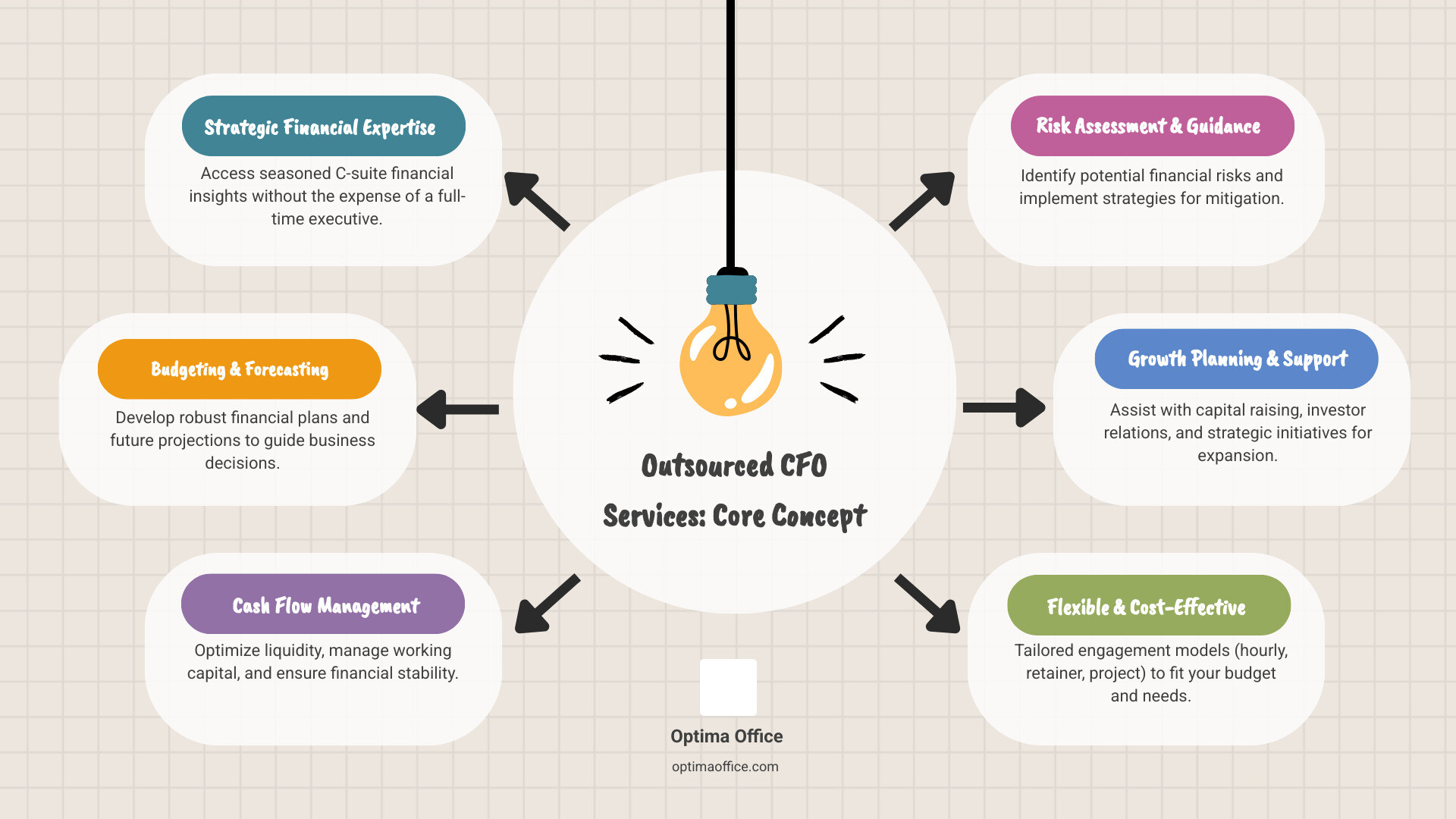
Founders wearing too many hats often delay strategic financial work. A fractional or outsourced CFO can quickly establish controls, build the forecast, and prepare investor materials at a fraction of full-time cost—especially useful when the need is tactical or temporary. Use outsourced CFOs for clear deliverables: build a rolling cash forecast, redesign the chart of accounts, and prepare a fundraising model within 30–60 days.
High finance team turnover and low capability
Frequent turnover in finance roles usually signals poor processes or misalignment between team skills and company needs. Stabilize the team by documenting processes, implementing systems that reduce repetitive work, and defining clear career paths. Outsourced controllers or interim hires can bridge gaps while permanent talent is recruited.
No clear ownership of metrics or close tasks
If no one is accountable for DSO, gross margin, or headcount reconciliation, metrics won't improve. Assign ownership: head of revenue owns pipeline conversion KPIs, finance owns DSO and reconciliations, product owns unit economics. Accountability converts dashboards into action.
When to hire versus when to outsource
Hire a full-time CFO when complexity and scale require ongoing strategic leadership—typically when recurring revenue, complexity of financing, and headcount exceed thresholds where a fractional resource can’t maintain relationships or institutional knowledge. Outsource when the immediate need is remediation, rapid scale-up for a raise, or when the company needs interim leadership while searching for the right permanent hire.
Transitioning out of diagnosis requires a prioritized, time-bound plan. The final section summarizes the fastest routes to regain visibility and control.
Concise summary and prioritized next steps
Regaining financial visibility is an execution problem with predictable levers. The priority sequence below produces rapid improvement in liquidity, reporting credibility, and fundraising readiness.
- Immediate (0–30 days): Build a rolling 13-week cash flow forecast, reconcile bank accounts, reduce high-risk AR by implementing immediate collection strategies, and establish a weekly cash review. These moves stabilize runway and buy time.
- Near-term (30–60 days): Close the last three months reliably; implement a month-end close checklist and resolve top 10 unreconciled GL accounts. Redesign the chart of accounts for decision-making and produce a board-ready pack that includes reconciled financials and variance analysis.
- Short-term (60–90 days): Transition transactional processes into a reliable accounting system with integrated feeds (billing, payroll, bank). Build a driver-based financial model with scenario planning and align it to fundraising needs. Clean the cap table and prepare a diligence folder.
- Medium-term (90–180 days): Implement controls (segregation of duties, payment authorization workflows), automate reporting, and hire or transition to a permanent CFO or retain a fractional CFO with KPIs and an onboarding plan. Standardize investor communications.
Concrete next actions that leaders can execute this week: run an emergency cash stress test to determine the minimum runway; assign a single owner to the rolling 13-week forecast; pull a current cap table and model one plausible financing scenario; and contract a fractional CFO or outsourced controller for an immediate 30–60 day remediation engagement. These targeted moves convert uncertainty into a plan and restore the credibility required to grow, raise capital, and make strategic trade-offs with confidence.